How do you get your first customer when you are new to selling?
You may have a useful skill, product, service, digital product, or business idea. You may even believe that people could benefit from it.
But there is a big difference between having something useful and finding someone willing to pay for it.
For beginners, the difficult part is often not the product itself. It is knowing who to approach, what problem to understand, what to offer, how to start the conversation, and what to do when the answer is no.
The good news is that selling does not have to begin with complicated sales funnels, expensive advertising, or aggressive persuasion.
A more practical starting point is to treat your first sale as a process of testing, learning, and improving.
What Does Your First Sale Actually Mean?
A first sale is not proof that an entire business will succeed.
It is simply evidence that, in a particular situation, a real customer decided that a particular offer was worth buying.
That distinction matters.
If someone buys your service once, you have learned something useful. But you still need to know whether other customers have the same problem, whether your pricing works, whether you can deliver the offer consistently, and whether you can find more suitable buyers.
This is why beginners can benefit from thinking about sales as a series of small tests rather than as a guaranteed formula.
1. Start With One Reachable Customer
One of the most common mistakes beginners make is trying to sell to everyone.
“Anyone who needs my product” is not a useful customer definition.
Instead, choose a specific group of people you can realistically reach.
For example, depending on what you sell, your potential customer might be:
- Local business owners
- Freelancers
- Parents
- Students
- Coaches or consultants
- Home-based businesses
- Creators
- Professionals in a particular field
- People with a specific problem or need
The goal is not to find the perfect customer profile immediately.
The goal is to choose a starting point that is specific enough to research and reach.
2. Understand the Problem Before You Pitch
A product can be useful and still be difficult to sell if you do not understand what the customer actually needs.
Before making an offer, learn about the problem.
Ask questions such as:
- What is the person trying to accomplish?
- What is making it difficult?
- What have they already tried?
- What is frustrating about the current situation?
- How important is the problem?
- Are they already spending money to solve it?
- What would make a solution useful to them?
This does not mean interrogating potential customers.
It means listening before assuming.
A good sales conversation often starts with curiosity rather than a pitch.
3. Create a Small, Clear Offer
Beginners sometimes create offers that are too broad.
Instead of trying to sell everything you can do, start with a clearly defined outcome.
For example, rather than:
“I provide digital marketing services.”
A clearer offer might describe a specific service, scope, and outcome.
The exact offer will depend on the customer and market, but the principle is simple:
Make it easy for the buyer to understand what they are buying.
Your offer should make clear:
- What is included
- Who it is for
- What problem it addresses
- What the customer receives
- How much it costs
- How long delivery takes
- What is not included
Clarity reduces unnecessary confusion for both the buyer and the seller.
4. Price the Offer Honestly
There is no universal “correct” price for a product or service.
Pricing depends on factors such as the market, customer, competition, scope, costs, experience, positioning, and the value the customer expects.
For a beginner, the important thing is to avoid inventing claims such as:
“This will definitely make you ₹1 lakh.”
or:
“You are guaranteed to double your sales.”
Unless you can properly substantiate an objective claim, do not make it.
A responsible offer uses real prices, clear terms, realistic scope, and honest expectations.
5. Find Your First Prospects
Once you know whom you want to help, you need people to talk to.
Start building a small prospect list.
You might identify potential customers through:
- Existing professional networks
- Local businesses
- Relevant communities
- Social platforms
- Industry directories
- Referrals
- Personal connections
- Appropriate online research
The objective is not to collect hundreds of random names.
It is to identify people who appear reasonably relevant to what you offer.
A smaller list of relevant prospects can be more useful than a large list of people who have little connection to your offer.
6. Personalize Your Outreach
Nobody likes receiving messages that obviously look copied and sent to hundreds of people.
If you contact someone, make the message relevant to them.
A simple structure can be:
Observation → Relevance → Question
For example:
I noticed that you are offering [specific service/product]. I work with [type of customer] on [specific problem]. Is improving [relevant area] something you are currently looking at?
The purpose of an initial message does not have to be closing a sale immediately.
It can simply be starting an appropriate conversation.
And if someone clearly says no, respect the answer.
7. Use Discovery Before Making the Offer
A useful discovery conversation helps you determine whether there is a genuine fit.
You can explore:
- The customer’s current situation
- The problem they are experiencing
- What they want to improve
- What they have already tried
- Their priorities
- Timing
- Decision-making process
- Whether your offer is actually suitable
Sometimes the right conclusion will be:
“My offer is not the right fit for you.”
That is not necessarily a failure.
Qualifying unsuitable opportunities can save time for both sides.
8. Ask for the Sale Clearly
If there is a genuine fit, do not make the customer guess what happens next.
Explain the offer clearly.
Then make the next step simple.
For example:
“Based on what you have described, I think this option would be suitable. It includes [scope], costs [price], and can be delivered by [time]. Would you like to go ahead?”
A clear question is usually better than vague statements such as:
“Let me know if you are interested sometime.”
You are giving the customer an opportunity to make a decision, not forcing them to make one.
9. Learn to Handle Objections
A customer may ask:
- Why does it cost that much?
- Can you reduce the price?
- How long will it take?
- What exactly is included?
- Why should I choose this?
- Can you guarantee the result?
- I need to think about it.
An objection does not automatically mean the customer is rejecting you.
It may mean they need more information.
Listen carefully before responding.
And do not manufacture urgency or pressure simply to overcome resistance.
If the customer is not ready or the offer is not suitable, accept that.
10. Follow Up Without Becoming Pushy
People get busy.
A follow-up can therefore be useful.
But there is a difference between professional follow-up and repeated pressure.
A simple follow-up might remind the person of the conversation and ask whether they would like to continue.
If they decline clearly, stop.
A sustainable sales process should not depend on making people uncomfortable.
11. Deliver the First Sale Properly
Getting paid is not the end of the process.
It is the beginning of your responsibility to the customer.
Confirm:
- What was purchased
- What will be delivered
- When it will be delivered
- What the customer needs to provide
- What is outside the agreed scope
- What happens next
Deliver what you promised.
If the customer asks for additional work, clarify whether it is part of the original scope or a separate request.
A professional first transaction can teach you as much about your business as the sales conversation itself.
12. Ask for Honest Feedback
After delivery, ask the customer about their actual experience.
Useful questions include:
- What worked well?
- What could have been clearer?
- What was most useful?
- What was missing?
- What would you change?
- Would you consider using this again?
If the customer voluntarily provides a review, use it honestly.
Do not create fake testimonials, fake reviews, or exaggerated success stories.
Real feedback is more useful because it helps you understand how customers actually experience your offer.
13. Learn From the “No”
Not every prospect will buy.
That is normal.
A “no” can sometimes provide useful information.
Perhaps:
- The customer did not have the problem
- The problem was not important enough
- The timing was wrong
- The offer was unclear
- The price did not fit
- The customer did not trust the offer yet
- The wrong prospect was approached
- Your solution was not a good fit
Instead of simply counting the rejection, ask:
What did this conversation teach me?
That question can make unsuccessful attempts more useful.
14. Measure the Sales Process
Once you start having conversations, keep basic numbers.
You can track:
- Relevant prospects
- Messages sent
- Replies
- Qualified conversations
- Offers made
- Sales
- Revenue
- Common objections
- Best-performing prospect sources
These numbers can help identify where the process is getting stuck.
For example:
Few relevant prospects?
You may need to improve your customer definition or prospecting channel.
Many prospects but few replies?
Your message, relevance, timing, or targeting may need attention.
Many conversations but few offers?
Your discovery process may need improvement.
Many offers but few sales?
You may need to examine the problem, value, trust, pricing, timing, or fit.
Do not treat small samples as forecasts. Early numbers are evidence for learning, not guarantees about future performance.
A Simple First-Sale Process for Beginners
If you are completely new to selling, you can reduce the process to five questions:
1. Who do I want to help?
Choose one reachable customer group.
2. What meaningful problem do they have?
Research before pitching.
3. What useful offer can I make?
Define a clear outcome, scope, price, and next step.
4. Who can I appropriately approach?
Build a small list of relevant prospects.
5. What can I learn from the response?
Track conversations, objections, offers, sales, and feedback.
This approach does not promise that everyone will buy.
It gives you a structured way to find out what happens when you put a real offer in front of real potential customers.
Why Beginners Often Need a Sales Process, Not Just Motivation
Motivation can help you start.
But a repeatable process can help you know what to do next.
Without a process, beginners often jump from one tactic to another:
- Try social media.
- Try paid advertising.
- Change the price.
- Create another product.
- Send more messages.
- Build another website.
- Start another business idea.
The problem may not be a lack of effort.
It may be a lack of evidence about where the current process is breaking down.
A simple sales process gives you something to examine.
Customer → Problem → Offer → Prospect → Conversation → Discovery → Decision → Delivery → Feedback → Improvement
That sequence creates a practical learning loop.
A Practical Resource for Learning the First-Sale Process
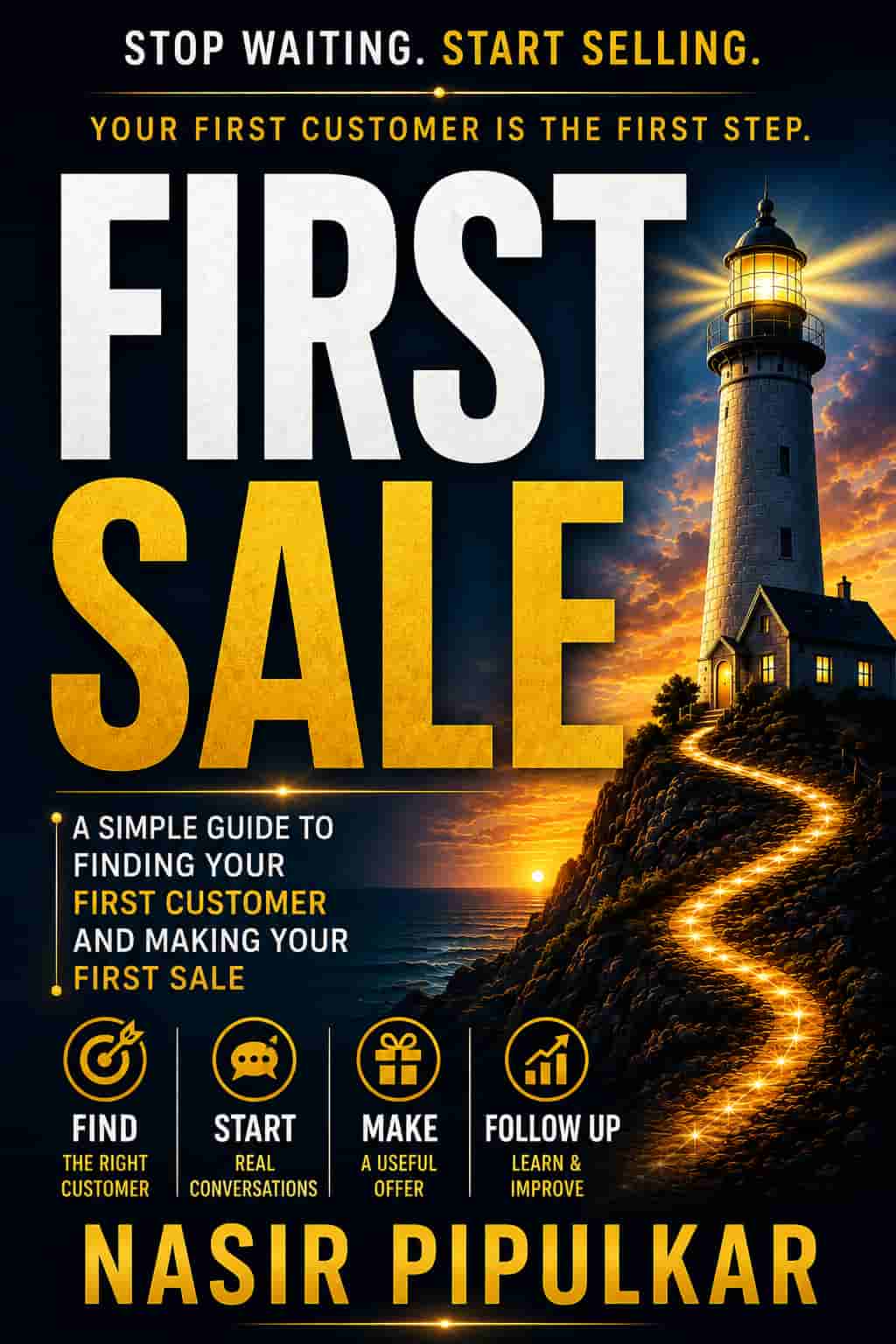
If you are looking for a structured way to learn these steps, FIRST SALE: A Practical Beginner’s Guide to Finding Customers, Making an Offer & Getting Paid by Nasir Pipulkar is designed specifically around this process.
The book covers customer research, customer fit, offer creation, pricing and boundaries, prospecting, personalized outreach, discovery conversations, qualification, presenting an offer, asking for the sale, handling objections, follow-up, payment, delivery, feedback, referrals, measurement, and fixing bottlenecks.
It also includes practical worksheets and templates for customer research, offer building, prospect research, discovery conversations, proposals, payment, follow-up, objections, delivery, feedback, referrals, prospect tracking, and sales measurement.
The book includes a 14-Day First-Sale Sprint and a 30-Day First Customer Momentum Plan, but these are action schedules rather than promises of a sale within those periods.
The underlying philosophy is straightforward:
Choose one customer.
Understand one meaningful problem.
Make one useful offer.
Start the conversation.
Learn from the evidence.
Is FIRST SALE Suitable for You?
This book may be useful if you:
- Are new to selling
- Have a skill you want to turn into an offer
- Are developing a small business
- Offer freelance or professional services
- Have a product or digital product to sell
- Are unsure how to find potential customers
- Struggle with starting sales conversations
- Want a practical sales process rather than motivational advice
- Want worksheets and templates to help you take action
It is not presented as a guaranteed-income system.
No book can guarantee that a particular reader will make a sale, because customer decisions, market demand, pricing, competition, timing, execution, and many other factors affect outcomes. The book itself makes this limitation explicit.
Start With One Customer Conversation
You do not need to understand every part of sales before you begin.
Start small.
Choose one customer group.
Understand one meaningful problem.
Create one useful offer.
Find a few relevant prospects.
Start appropriate conversations.
Listen carefully.
Record what happens.
Then improve the next attempt based on what you learn.
That is a much more practical starting point than waiting until everything is perfect.
If you want a structured beginner’s guide to finding customers, creating an offer, starting sales conversations, and learning from the process, explore FIRST SALE by Nasir Pipulkar.
A first sale is not the finish line.
It is one piece of evidence that can help you understand what to improve next.
FIRST SALE: A SIMPLE GUIDE TO FINDING YOUR FIRST CUSTOMER AND MAKING YOUR FIRST SALE