When You Don’t Know What to Do: A Simple Way to Make Better Decisions
A practical approach to decision-making when your mind feels confused, pressured, or uncertain
We make decisions every day.
Some are easy: what to eat, what to buy, what task to finish first.
But some decisions stay in our minds for days, or even weeks.
Should I change my job?
Should I start something of my own?
Should I accept this opportunity?
Should I take the risk?
Should I wait?
Should I say yes, or no?
The difficult part is often not the lack of choices.
It is the confusion around those choices.
Fear, excitement, incomplete information, pressure from others, and the desire to be certain can make even a simple decision feel complicated.
And this is where one small habit can help:
Pause before you decide.
Not every decision needs hours of analysis.
Not every decision should be made immediately either.
Sometimes, what we need is a short pause that creates enough distance between our first reaction and our actual decision.
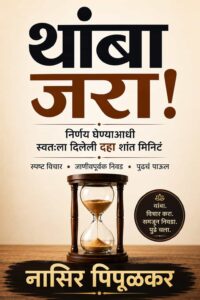
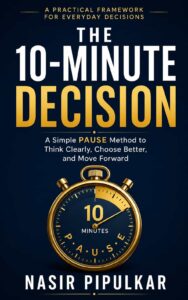
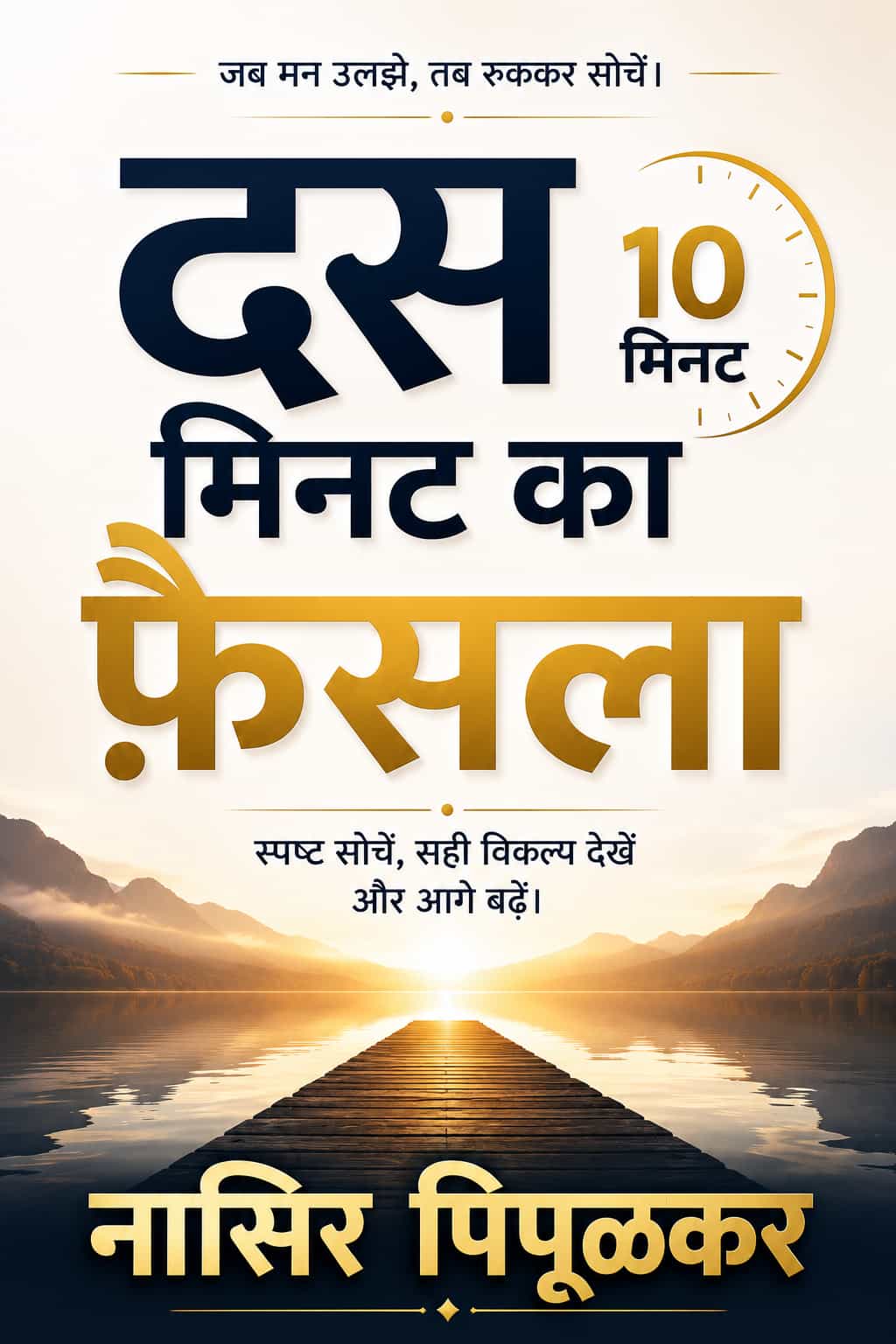
That simple idea is at the heart of the Hindi book दस मिनट का फ़ैसला (Dus Minute Ka Faisla) by Nasir Pipulkar.
Why Do We Struggle With Decisions?
One reason is that we often ask ourselves the wrong question.
For example:
“Should I leave my job?”
This sounds like a straightforward question.
But what if the real problem is low pay?
Or a difficult work environment?
Or lack of growth?
Or simply the desire to do something different?
The better question might be:
“What problem am I actually trying to solve?”
Once the question becomes clearer, the decision often becomes easier to examine.
Don’t Let Emotion Make the Entire Decision
Emotions are not the enemy.
Fear can warn us about risk.
Excitement can show us an opportunity.
Anger can tell us that an important boundary has been crossed.
But there is a difference between listening to an emotion and letting that emotion make the entire decision.
A decision made in anger may look different the next morning.
A decision made in excitement may look different after the excitement fades.
A simple pause allows you to ask:
“What is this emotion trying to tell me?”
And then:
“What do the facts say?”
Are There Really Only Two Choices?
We often think in pairs:
Stay or leave.
Yes or no.
Buy or don’t buy.
Start or don’t start.
But sometimes there is another possibility.
For example, instead of leaving your job immediately to start a business, you might first test your idea on a small scale.
Instead of saying yes or no immediately, you might ask for more information.
Instead of making a large commitment, you might run a small experiment first.
Finding a third option does not automatically make it the right option.
But it can make your thinking more flexible.
Facts, Assumptions, and What You Don’t Know
This is one of the most useful distinctions when making an important decision.
Ask yourself three questions:
What do I know?
What am I assuming?
What don’t I know yet?
For example:
“I think people will buy my product.”
That is an assumption.
“Three people have already said they would pay for it.”
That is information based on actual feedback.
“I don’t yet know whether enough people will pay for it.”
That is something you still need to learn.
Separating these three things can prevent assumptions from quietly becoming “facts” in our minds.
Every Choice Has a Price
We naturally focus on what we will gain.
But every decision also involves something we give up.
More money may mean more responsibility.
More freedom may mean less stability.
A new opportunity may require more time.
A safer option may offer less growth.
So ask two simple questions:
What will I gain?
What will I have to give up?
A realistic decision considers both.
You Don’t Always Need Complete Certainty
One of the biggest traps in decision-making is waiting until we are completely sure.
But the future cannot be known with complete certainty.
Before changing jobs, you cannot know everything about your new workplace.
Before starting a business, you cannot know exactly how many customers you will get.
Before taking an opportunity, you cannot know every possible outcome.
The goal is therefore not to predict the future perfectly.
The goal is to make a responsible choice using the information available today.
What Is “दस मिनट का फ़ैसला”?
दस मिनट का फ़ैसला is not a promise that every decision can literally be solved in ten minutes.
The book itself makes this distinction clear.
Ten minutes is a practical pause, not a magic formula.
Some small decisions may take only moments.
Some important decisions may require days or weeks.
The idea is to create a short space between reaction and decision so that you can think more clearly.
The book gives readers a simple decision process that looks at:
- the real question
- facts and assumptions
- alternatives
- priorities
- costs and trade-offs
- risks
- small experiments
- advice from others
- the next practical step
It also includes practical tools such as a 10-Minute Decision Method, 1-Minute Quick Check, and Decision Worksheet.
A Simple Question to Try Today
Think about one decision that has been occupying your mind.
Now write:
“What exactly am I trying to decide?”
Then write:
“What do I actually know?”
Then:
“What am I assuming?”
Then:
“What is one other option I have not considered?”
Finally:
“What is the next small step I can take?”
You may not have the complete answer.
You don’t need to.
You may simply have a clearer next step.
And sometimes, that is enough to move forward.
For Hindi Readers Who Want a Practical Guide to Decision-Making
If you prefer reading personal-development ideas in simple Hindi, दस मिनट का फ़ैसला was written specifically in an accessible, practical style.
It does not promise perfect decisions.
It does not tell you what decision to make.
Instead, it encourages you to pause, think, examine your options, understand the trade-offs, and take a considered next step.
दस मिनट का फ़ैसला
जब मन उलझे, तब स्पष्ट सोचने, सही विकल्प देखने और अगला कदम उठाने की एक सरल किताब
लेखक: नासिर पिपूळकर
If you have an important decision on your mind, this may be a useful book to keep nearby, not because it can predict your future, but because sometimes a few quiet minutes of clear thinking can change the way you see a choice.
Available on Amazon Kindle: दस मिनट का फ़ैसला (Dus Minute Ka Faisla)